 Play with Power |
|
||||||||||||||||||||||||||||||||||||||||||||||||
|
|||||||||||||||||||||||||||||||||||||||||||||||||
|
Microsoft is nothing if not savvy about marketing. The reviewer's copy of Urban Assault we received the other day came with as much of a full press kit as you can put on a CD, including background files that nearly amount to prewritten articles, gobs of screen shots, and even Internet Explorer 4.0. These folks really know how to sell a product.
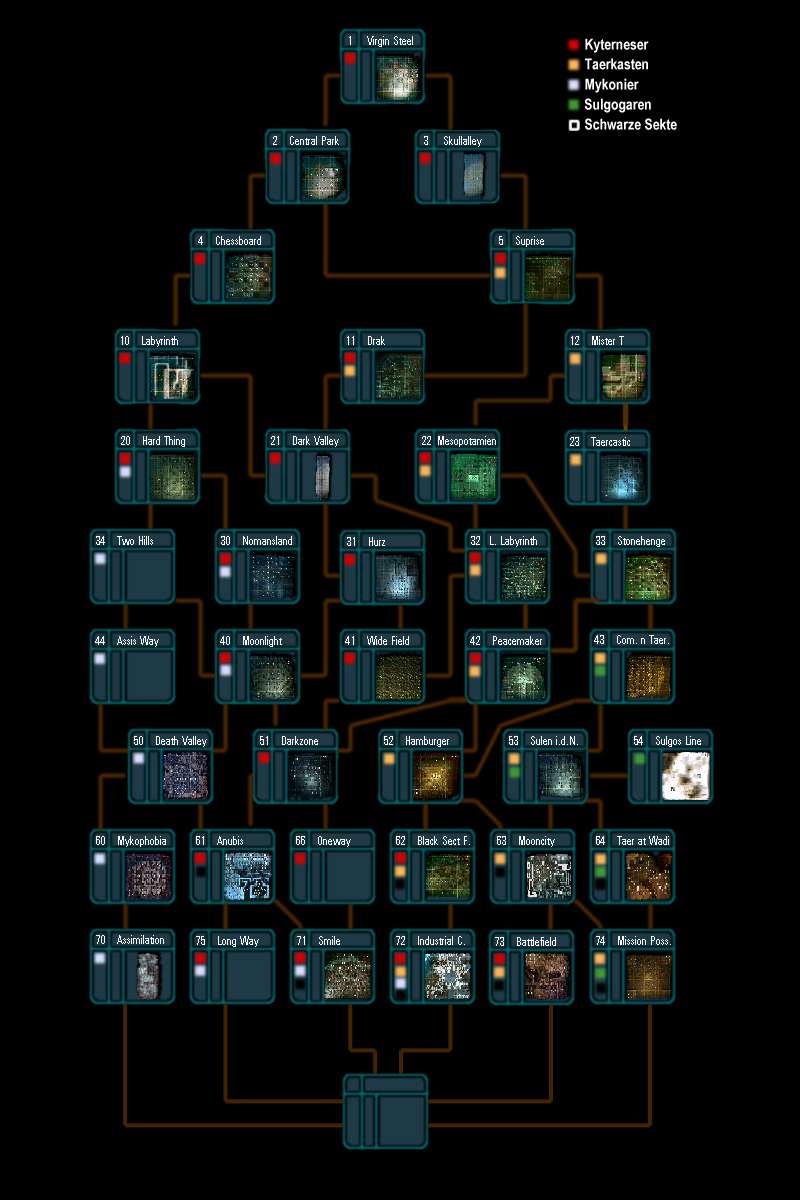
No matter. The opening sequence is a nice piece of art and really sets the stage for the player's task at hand; which is, to go on a series of missions in various venues as the commander in charge of an almost magic "host station" construction rig from which you can build fleets of tanks and aircraft and guide them against various enemies to complete your objectives. The background for the game is covered very thoroughly at GameSpot's Urban Assault Preview so we won't duplicate their fine effort here. Basically, civilization on Earth fell apart after "The Big Mistake" - a euphemism for the ecological disaster we currently call the Twentieth Century - and society broke down into a pockets of warring factions. Thus, "allies are non-existent". This part is OK, well, not OK, but OK for a game premise. But where they kind of lost me is when the Earth is then attacked by several alien species who begin sucking the planet's core of all energy, yet we still have no human allies. So, let me get this straight, a bunch of aliens are killing the planet and we're still arguing about some old girlfriend or something. I don't think so. Some of this is explained further into the story, but at the beginning it seems a bit far fetched. Meanwhile, all these factions happen to have nice play balancing characteristics like "very powerful high tech weapons but lousy shields" and "lousy weapons but heavy shields". Well, uh, I'm pretty sure that aliens travelling between stars would not really have that much trouble extinguishing earthlings still running Microsoft Windows as their primary cyborg operating system. They could have made the game just as fun and the story line a lot more accessible to our leap of faith if they had left the alien invaders out of the picture and just left us to play out that age old pastime of humans annihilating humans. But, if you can get over the whole alien invasion thing, the story is well told and sets up the game nicely. The game itself is very playable despite several flaws. You choose your mission from a space-down view overlooking Europe. You select the territory where you wish to start your mission. In the first few missions, you work in training zones, then move off to the Front. After you capture a territory, you are offered missions in adjoining territories similar to how it was done in Dune II. Each mission area has its own terrain, enemy races and mission goals. The mission goals involve capturing technology, removing invaders or completing other primary and secondary goals. Since you can branch through the missions in many different ways, you may not have the technology needed to succeed in some missions, and then you would have to go back and play another mission to acquire that technology. In the mission briefing screen, the starting point of enemy units and the locations of key sectors, technology upgrade sectors and jump gates are revealed. This revelation occurs slowly, one unit every three seconds, which seems like a long time. When everything is revealed, it loops through everything again. I would prefer it if the whole map was revealed in one fell swoop rather than slowly... revealing... it... unit... by... unit... by... unit. A little movie plays at the start of each mission in which a nice computer lady narrates maps and videos to give you background information and tactical tips concerning your enemy and the terrain. The movie isn't bad, although it does get repetitive over time (maybe they'll have more movies in the final game) and seems lo-res compared to actual game play on a voodoo card. Also, sometimes the nice computer lady's advice isn't that great, such as when she told me to "use my superior air power" against tanks when I hadn't developed any aircraft technology yet. The training missions are excellent. A lo-res movie introduces you to the game controls. In the mission, as you bumble around in the mission area, the nice computer lady gives you advice on completing the mission. A very good HTML help file is provided, although launching help brings you back to the desktop and Internet Explorer, thus destroying immersion. Also, within the game the light bulb icon will give you text advice as to what to do next.
Once in a mission, you start with low tech equipment and add new unit types by capturing technology upgrade sectors on the map. Resource management is done by capturing power stations, then teleporting your host station on top of it to maximize its use. You can also capture sectors around the power station to increase the output of the station. The only the host station can teleport (unless I missed acquiring some technology). The rules for teleporting the the host station are a little bogus, and without explanation. You can teleport to a power station from anywhere for free, but teleporting anywhere else uses up energy. During the game, you may wish to teleport around to build turrets and such in specific locations, but remember that you get a lot more energy by roosting the host station right on top of the power station. The host station has a few guns, but if you lose the host station, its game over. To exit a mission, you capture a jump gate, move as many units as will fit into the jump gate, then teleport the host station on top of the jump gate. There is some resource management here too. The jump gate only holds a small number of vehicles. Since you can't take everybody with you, you have to choose which units to take. These units will then be available on your next mission. Another odd game rule is that whenever you destroy an enemy host station, the number of vehicles you can take through jump gates increases by one. When sending your units to the jump gate, it helps to set their aggressiveness level to "go to target". Otherwise, they tend to roam around and you won't get them all in when you jump. It can be a little annoying at the end of a mission, after defeating all enemies and are low on energy, and you are teleporting the host station to the jump gate, you have to make multiple hops just to exit the mission. A good feature would be to allow teleporting to a jump gate for free, although this would eliminate certain hair-raising situations where you are desperately seeking the safety of a jump gate. I'm not sure of the value of this feature, but you can go back to a previously captured territory, make new units, move them to the jump gate, then jump with them back to the satellite.
To create units from your host station, you click on an icon at the bottom of the screen then select the unit type you want to create. Then click on the spot where you want the unit created. To create multiple units, click repeatedly. Simple. Unless you are low on resources or units are especially complex, they are created almost immediately in a single squadron. Creating structures follow the same paradigm, although it takes a bit of practice to place structures just where you want them. Created units and structures cannot be sold and you are limited as to the number you can take with you on the next mission, so be careful with your resources.
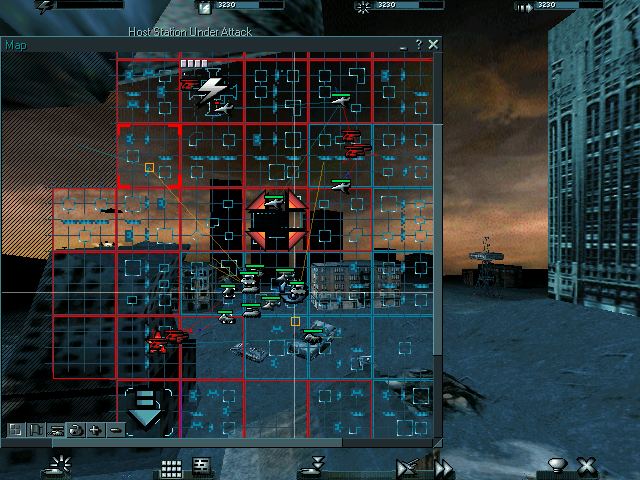
The transparent map is where most of the work is done. The map is a cross between a HUD display and a movable sizable window. You can minimize it to a small box in the corner, resize it, and scroll. The map has two zoom levels. From far out, your units are little blue dots and the bad guys are other colors, depending on faction. Zoomed in, the units are icons. The map only shows what your units can see. Although key sectors, technology upgrade sectors and jump gates were shown in the map provided at the mission briefing while we were in our comfy satellite, your cyborg's version of ActiveX can't transfer that data to the transparent map once your planetside. So, you have to explore the map to find your goals. The transparent map works great. Its not as interesting as the top view from Total Annihilation or most other recent real-time strategy (RTS) games, but it has all the needed tactical and strategic information clearly displayed. Little icons on the bottom let you turn on and off levels of detail such as buildings, sectors grids, and unit status.
The sounds succeed in keeping you tactically informed and engaged in the game. Each unit has a unique voice and style of report. They report enemy sightings, waypoints reached, cries for help and other needed info. A little "i" symbol appears by a unit when it reports in so you know who's talking. It can get a little repetitive, but the information from the radio is necessary to run the battle. Atmospheric sounds of tanks moving and planes flying are well done. The music is reasonably dark and motivating, and unlike most recent games, I didn't feel an instant urge to shut it off.
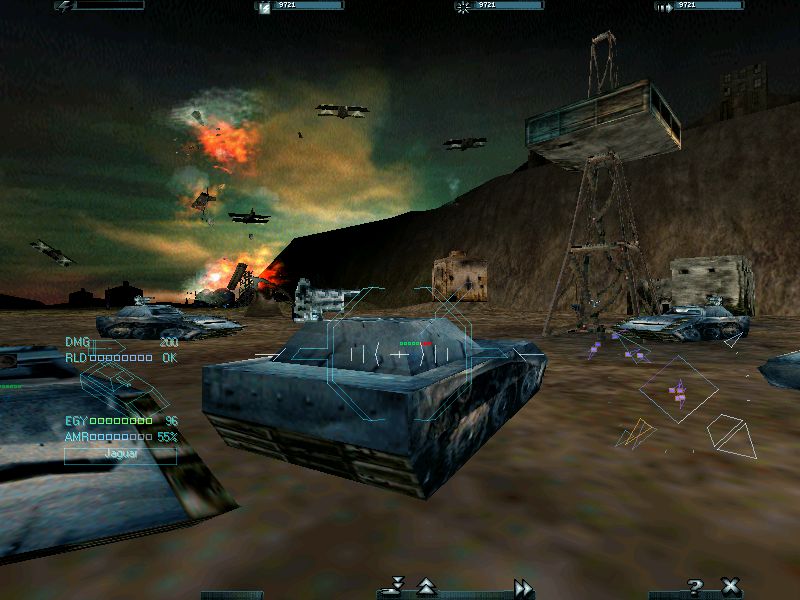
This is not a vehicle simulator. There is nothing to do in the vehicles but drive and shoot. There are little physics effects and no cockpits. Jets can hover just like choppers. There is no collision damage. Choppers can do a summersault on the ground upside down, then fly off. Although each vehicle does have its own characteristics, they are all pretty much basic transportation, each with their own weapons, speed, armor and maneuverability. You cannot customize your vehicles, but if you pay attention to the messages you get when you receive technology upgrades, you can see your little fleet get better armor and weapons. Energy weapons must recharge before firing again. Aircraft are Descent-like speedsters. The tanks can only move the firing position within the forward view, so there isn't a perception of a turret. Driving the air units is somewhat natural. Heavy tanks are more difficult to maneuver and have more trouble going up hills than light tanks. The ground units control system was impossible until I switched to "alternate joystick" control mode. This allowed the Saitek stick and throttle to be used effectively. I think the best control setup for tanks might be to have the throttle control speed and buttons, use the rudder pedals to steer, and the mouse to aim the turret within the view and fire, but unfortunately there wasn't a way to set it up like that. But for those without a throttle, the ability to use a number key for throttle control and direction (`-4 back, 5 stop, 6-0 forward) would help a lot. And you do need to take control or you will get killed as advertised. The strategy for the game is all about capturing territory. You need to capture power plants (or build them once you have the technology), then capture squares around the power plants to increase their power output. You also need to capture technology updates and jump gates, as well as "key sectors" assigned in the mission briefing. You capture a square by sending a unit in with its aggressiveness set to "capture all territories". Being in a territory and shooting the ground generally captures it, but you may also have to clear all enemies from it. For some missions, you can send a fast light tank into a territory and it will skirt the opposition and capture it, so you get your upgrade. I don't think you lose your upgrade if the enemy captures a technology upgrade back, but I couldn't convince and enemy to take back the sector so didn't get a chance to test this theory. Unit AI is good but not great. Enemy host stations pretty much build units and send them to waypoints, and when your units show up on their radar, they come after you. They usually like to stay in their patrol zones, so if you run they often back off and return to their position. I didn't get the sense that the enemy was sending a small party one way to draw my forces out so they could come in another way, or that they set up ambushes and worked to draw units in. Leave that to multiplayer. The main challenge for each level is to build the right mix of units and to coax the enemy into your own ambushes to eliminate them. Units usually do an adequate job of path finding through the towns and around obstacles, but sometimes they do get stuck. Some units are fairly suicidal. Some levels are too easy and its difficult to tell whether this will change in the final product. In other levels, though, the superior weapons of the enemies quickly decimated any offense. In this situation, you are faced with the option of backing out and going down a different route toward manifest destiny which will hopeful give you more technology to beat the harder foes. Still, expert players might find the game too easy and there is no option for difficulty. The code is fairly solid. One blatant coding error jumped out during the entire session, and it was in an obscure case. I loaded a mission and completed it, earning a helicopter technology upgrade. But wasn't happy with the way it went, so I pressed escape and said "Load last saved" figuring it would take me back to where I started. Nope. It took me back two missions, to the last time I had saved within a mission (I think). The good news and bug is that I still had my helicopter technology. I also had some occasions where setting the path for vehicles on the map stopped working. Some of the messages were not very clear ("Do you really want to restart the game" when restarting the mission), and there's a typo in the "Fort Grenada" mission briefing. But these were relatively minor problems for a beta release. We didn't try multiplayer but this thing look like it could be a great multiplayer game. Its easy to imagine epic battles raging as the pristine cities slowly go down in flames. The terrain is a real challenge for ground forces. Tanks can't go over some mountains and slow down considerably in hills, so a host station under ground attack can teleport into the mountains for cover. We'll have to wait and see, but it could be real nice. This game is big fun. We have a case here where the whole seems more than the sum of its parts. This is the best example yet at combining strategy and first person perspective. While not perfect, the interface is clean and well thought out and the game succeeds in many subtle and important ways. While the graphics are not breathtaking, and the story doesn't always hold water, and the vehicle control needs work, and a lot of the rules of the game seem like, well, rules of a game, this game turns out to be engaging and fun. When it comes down to it, no greater complement can be given a game. And the more I played it, the more I liked it. There's room for improvement, but the bottom line is, Urban Assault plays like a winner. Lets just hope my Cyborg counterpart doesn't encounter a "blue screen of death" any time soon.
Related Links: Reviewed for GameBlazer.com by Chad (07/31/1998) |
||||||||||||||||||||||||||||||||||||||||||||||||



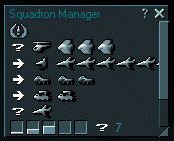 The squadron
manager consists of a line for each squadron and little unit icons on
each line. Drag and drop units to move them among squadrons. You can select a
squadron and give it an aggressiveness level. The lowest level returns to the
host station. The highest, fifth, level destroys everything in its path
including buildings. The unit manager works pretty well, but sometimes you find
yourself spending quite a bit of time and clicks rearranging units. Note that
the first unit is the squadron leader. If you move a squadron leader to another
squad, the whole squad moves with it. It would have been nice if this (and
setting waypoints, and looking around), could be done in pause mode, which
currently goes to a black screen.
The squadron
manager consists of a line for each squadron and little unit icons on
each line. Drag and drop units to move them among squadrons. You can select a
squadron and give it an aggressiveness level. The lowest level returns to the
host station. The highest, fifth, level destroys everything in its path
including buildings. The unit manager works pretty well, but sometimes you find
yourself spending quite a bit of time and clicks rearranging units. Note that
the first unit is the squadron leader. If you move a squadron leader to another
squad, the whole squad moves with it. It would have been nice if this (and
setting waypoints, and looking around), could be done in pause mode, which
currently goes to a black screen.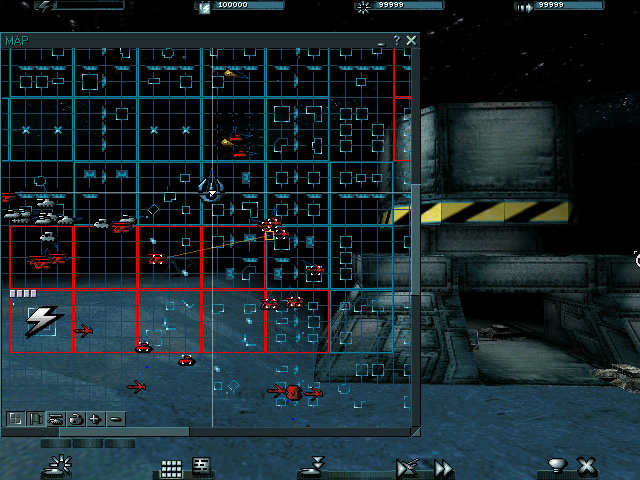

|
|
|
|
|
| Web page problems? Please contact us. | |
|
Material and Code Copyright
© 1999, ZeBlazer
Systems Incorporated. All rights reserved. "GameBlazer", "Swap-and-Play",
"Intergalactic Catalog", "The Power of Fun", "ZeBlazer" and the little blue jet
image are trademarks of ZeBlazer Systems Incorporated. GameBlazer and this site
may include information which may be copyrighted by game publishers and
developers. This information remains the property of its owners and is used
with permission or within their guidelines for use. Game and site names may be trademarked and remain the property of their owners. |
|